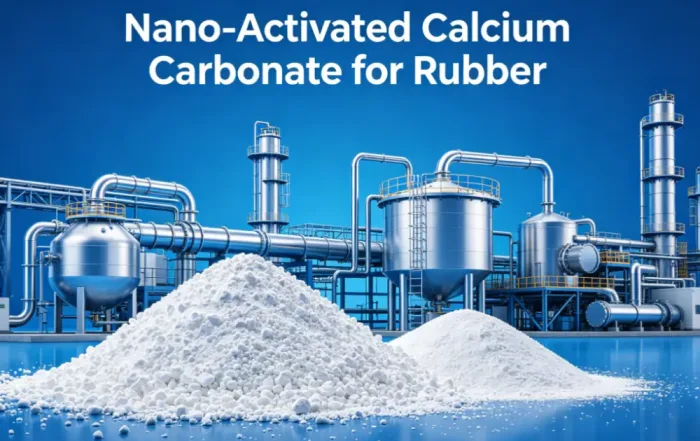
Why Rubber Is a Key Application for Nano Calcium Carbonate
In the rubber industry, calcium carbonate is the third largest inorganic filler after carbon black and silica. However, ordinary ground calcium carbonate (GCC) or precipitated calcium carbonate (PCC) offers little more than volume extension — they primarily reduce cost without improving performance.
Nano-activated calcium carbonate (NACC) changes this paradigm. Through surface modification and precise particle size control (15–90 nm), NACC delivers genuine reinforcing effects that traditional calcium carbonates cannot achieve.
Key rubber applications include tires (sidewall, carcass ply, inner liner, cushion compound), hoses and belts, wire and cable (mining, high-voltage, marine cable sheathing), seals, gaskets and rubber footwear, as well as silicone rubber (both RTV and HTV).

Key Advantages over Ordinary Calcium Carbonates
Genuine Reinforcement, Not Just Filling
Ordinary calcium carbonate acts as a simple extender — it adds volume but does little for mechanical properties. NACC provides semi-reinforcing to reinforcing performance.
Documented improvements in natural rubber include tensile strength increases of 37 to 44 percent, significant tear strength gains, one to five times improvement in flex resistance, and noticeably enhanced abrasion resistance. In NBR, SBR, and butyl rubber, NACC can increase vulcanizate strength by 33 to 41 percent while saving 5 to 10 percent of raw rubber.
Superior Dispersion and Compatibility
Untreated nano-calcium carbonate agglomerates easily. NACC undergoes surface modification using agents such as stearic acid or coupling agents like titanate or aluminate. This makes the material hydrophobic and organophilic, highly compatible with NR, NBR, SBR, IIR, EPDM, and silicone rubber. It is also easier to disperse, resulting in fewer defects and smoother surfaces.
Studies show that using aluminate coupling agents yields higher strength, elongation, and tear resistance compared to conventional treatments.
Improved Processing and Vulcanization
NACC positively influences rubber processing. It adjusts Mooney viscosity and increases plasticity, improves dimensional stability of finished parts, and reduces shrinkage. When moisture content is controlled below 0.5 percent, NACC shortens scorch time.
In chlorinated polyethylene rubber, NACC shows minimal negative impact on processing fluidity while effectively promoting crosslinking reactions.
Enables Cost Reduction by Partially Replacing Expensive Fillers
One of NACC’s most practical advantages is its ability to partially or fully replace carbon black or white carbon black (silica) in non-critical stress areas.
While pure NACC cannot match the full reinforcement of carbon black, blending NACC with carbon black or silica achieves comparable mechanical properties at significantly lower cost. This is particularly valuable for tire sidewalls and inner liners where stress is lower, as well as for colored or light-colored rubber products where carbon black is unsuitable.
Special Functionality: Anti-odor and Antibacterial Effects
Due to its nano-scale photoactivity, NACC can decompose organic compounds under UV or sunlight exposure. When applied in rubber footwear or decorative rubber products, this provides deodorizing, antibacterial, and anti-mold effects — an added value feature unavailable with ordinary fillers.
Where Attention Is Needed
Optimal Particle Size: 80 to 120 Nanometers
For rubber applications, particles finer than 80 nanometers become increasingly difficult to disperse and may cause heat build-up and sticking during mixing. The recommended range is 80 to 120 nanometers, balancing reinforcement and processability.
Crystal Morphology Matters
Among different crystal forms, chain-like (vermicular) nano-calcium carbonate provides the best reinforcement for rubber. Cubic or spindle-shaped particles offer different performance profiles.
Surface Treatment Must Be Optimized
Excessive surface treatment agent such as sodium stearate actually reduces tensile and tear strength while increasing elongation. The optimal dosage must be determined for each formulation.
pH and Moisture Affect Vulcanization
For rubber applications, NACC typically requires a pH between 9 and 10.5. Lower pH slows vulcanization, lengthens scorch time, and increases energy consumption. Moisture should be kept below 0.5 percent. Higher moisture shortens scorch time but can cause porosity defects.
Slight Vulcanization Delay
Some studies report that NACC slightly delays vulcanization in certain formulations such as chlorinated polyethylene rubber. However, this remains well within acceptable processing windows and does not hinder production.
Application Recommendations
Nano-activated calcium carbonate is strongly recommended for tire sidewall and inner liner applications where partial replacement of carbon black is desired. It is also strongly recommended for colored or light-colored rubber goods where traditional fillers are unsuitable.
For hoses, belts, seals, and wire and cable sheathing, NACC is a recommended choice that improves insulation and mechanical performance. In silicone rubber (both RTV and HTV), NACC is recommended for reducing silica usage while maintaining performance.
For ultra-low-cost bulk filling applications, ordinary ground calcium carbonate or conventional precipitated calcium carbonate may be more appropriate. For high-stress tread compounds, NACC should be used only in blend with carbon black or silica, not as a standalone reinforcing filler.
Summary
Nano-activated calcium carbonate has transformed from a simple filler into a genuine functional additive for the rubber industry. It offers reinforcement with measurable improvements in tensile, tear, and flex resistance. It provides compatibility with excellent dispersion in most rubber matrices. It enables cost efficiency through partial replacement of expensive carbon black and silica. And it delivers added value such as antibacterial and deodorizing effects for specialty products.
For rubber manufacturers seeking to balance performance, cost, and processing, NACC represents a proven upgrade from conventional calcium carbonates.