Nano-activated calcium carbonate (NACC) has emerged as the most widely used functional filler in the plastics industry, accounting for over 31% of the total market share in filler applications. Its unique integration of nano-scale particle size, professional surface modification, and excellent compatibility with organic polymers distinguishes it significantly from conventional ground calcium carbonate (GCC) and precipitated calcium carbonate (PCC).
This article provides a practical, technology-driven overview to help plastics manufacturers, formulation engineers, and procurement decision-makers understand:
- Why NACC outperforms other calcium carbonates in plastics
- Where its limitations remain
- How to select and process it effectively
1. Why the Plastics Industry Is the Largest Consumer of NACC
NACC is extensively applied across key plastic product categories, including:
- PVC pipes and profiles
- Wire and cable compounds
- Engineering plastics (automotive, appliances)
- Plastic films and sheets
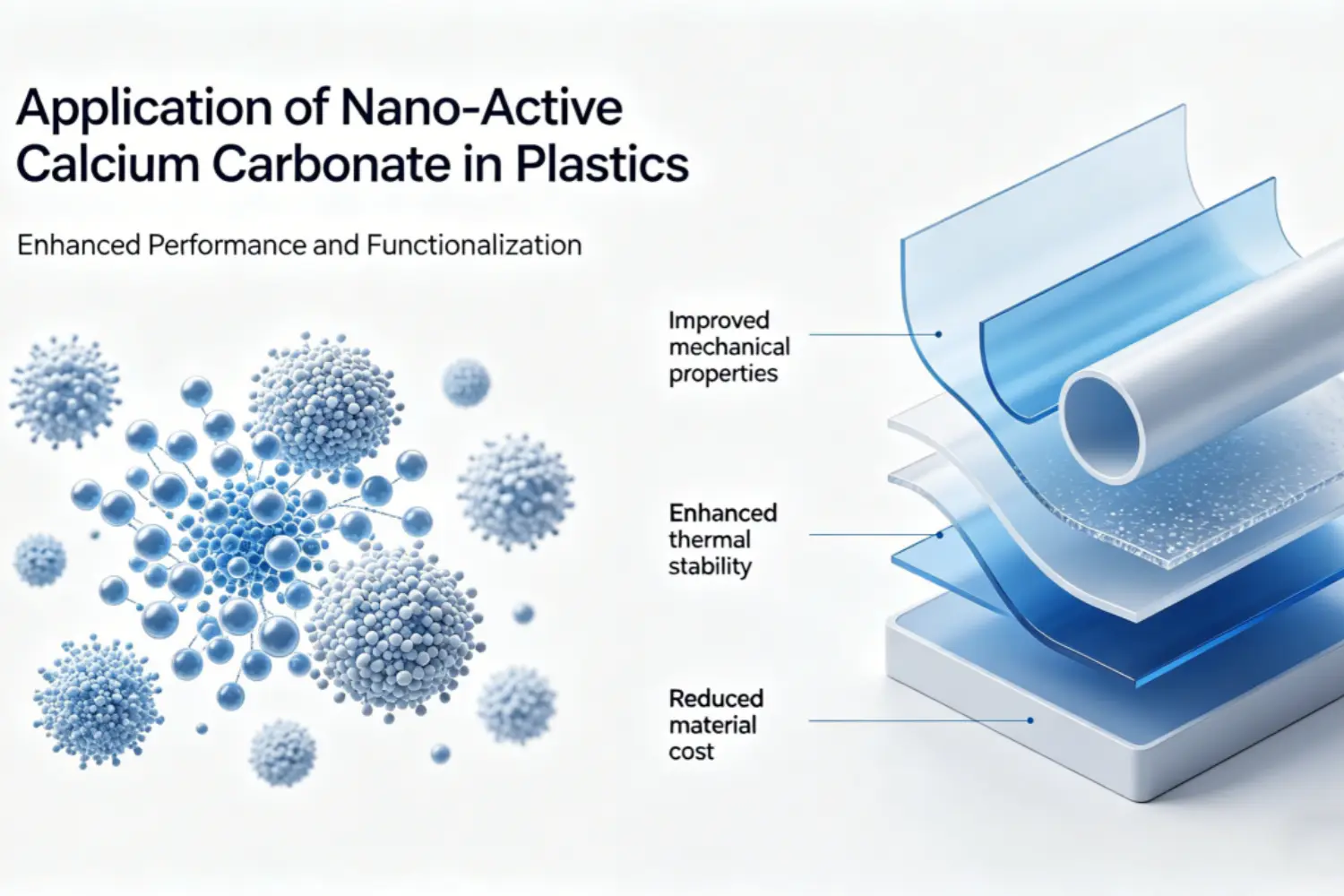
The core driving factor is clear: NACC offers more than just cost reduction. It effectively enhances mechanical performance, surface quality, and processability—advantages that GCC and unmodified PCC cannot match, especially at high filling levels.
2. Key Advantages over Other Calcium Carbonates
Compared with GCC (coarse-grained and untreated) and conventional PCC (unmodified or with larger particle sizes), NACC demonstrates distinct advantages in plastic applications.
2.1 Reinforcement without Sacrificing Toughness
- GCC primarily serves as a low-cost extender, but it significantly degrades the tensile strength and impact resistance of plastic products.
- NACC, due to its nano‑scale size (20–100 nm) and surface activation, provides both stiffening and toughening.
- In PVC formulations, adding 5% modified NACC can increase tensile strength by approximately 10% while maintaining excellent impact resistance.
- This enables formulation engineers to partially replace high-cost fillers (e.g., titanium dioxide, fumed silica) without compromising product performance.
2.2 Better Dispersion and Compatibility
Untreated nano-CaCO₃ is prone to severe agglomeration. Through surface modification (e.g., treatment with stearic acid or titanate coupling agents), NACC gains hydrophobic and organophilic properties, resulting in:
- Lower oil absorption (19–28 g/100 g vs. ~50 g/100 g for GCC)
- Reduced torque and shorter fusion time during mixing
- Fewer surface defects (white spots, drag lines) in finished parts
2.3 Improved Surface Quality and Dimensional Stability
For extruded profiles, pipes, and calendered sheets, NACC delivers the following performance enhancements:
- Higher gloss and smoothness
- Lower shrinkage → better dimensional accuracy
- Improved stiffness without brittleness
2.4 Higher Filling Levels with Less Property Loss
When high filler loading is required to reduce production costs, the performance retention of different fillers at high loading levels is clearly differentiated as follows:
| Filler Type | Property Retention at High Loading |
| GCC | Very Poor |
| Unmodified PCC | Moderate |
| Nano-activated PCC | Best |
Under the same mechanical performance requirements, NACC allows for 30–50% higher loading compared to conventional light calcium carbonate.
3. Limitations and Practical Challenges
No material is perfect, and NACC also has practical limitations in plastic applications. The key constraints are outlined below.
3.1 Agglomeration Remains a Risk
Despite professional surface treatment, nano-particles are still prone to re-agglomeration if not properly dispersed during processing.
- In actual production, the size of agglomerates can reach 10 µm or larger, far exceeding the primary particle size of 60 nm.
- Poor dispersion leads to defects, reduced reinforcement, and inconsistent quality.
3.2 Higher Cost
The production of NACC involves processes such as controlled carbonization, crystal shape engineering, and surface modification, making it significantly more costly than GCC or standard PCC. For non-critical, low-cost bulk plastic applications, the additional value brought by NACC may not justify its higher cost.
3.3 Limited Suitability for Transparent Products
Although special modification (e.g., barium sulfate coating) can improve the transparency of PE films to approximately 89% light transmission, NACC generally reduces the clarity of plastic products. For high-clarity packaging applications, alternative fillers or lower NACC loading levels are recommended.
3.4 Moisture Sensitivity and Stability
Uncoated or poorly coated NACC is susceptible to moisture absorption and exhibits alkaline reactivity. In acidic or humid environments, its stability may be compromised unless advanced coatings (e.g., silica encapsulation) are applied—this will further increase production costs.
3.5 Biocompatibility Concerns for Food Contact Applications
In food-contact plastic products, the migration potential of nano-particles has not been fully resolved. High temperatures or prolonged contact may weaken the polymer-filler interface, raising safety concerns that require additional professional evaluation.
4. Application Recommendations
Recommended Applications
- Engineering plastics requiring high strength and toughness
- High‑filling formulations (>30 wt %)
- Surface‑sensitive applications (glossy profiles, automotive parts, wires and cables)
- PVC pipes, fittings, and calendered sheets
Not Recommended (or Use with Caution)
- Highly transparent films (unless using special‑grade NACC)
- Ultra‑low‑cost, non‑critical fill applications
- Food‑contact plastics without thorough migration testing
Processing Guidelines
- Feed order: polymer + NACC → dry mix → liquid additives
- Use appropriate mixing temperatures and high‑shear equipment
- For very high loadings, select application‑specific surface‑treated grades
5. Conclusion
Nano-activated calcium carbonate has rightfully become the leading functional filler in the plastics industry—not due to its low cost, but because it delivers measurable performance improvements in areas where GCC and conventional PCC are insufficient.
Its advantages in reinforcement, surface quality enhancement, and high-loading capability make it the preferred choice for high-demand plastic applications. However, successful application of NACC requires a clear understanding of its limitations: agglomeration risk, higher cost, and reduced transparency.
For plastics manufacturers seeking to balance product performance, processability, and production costs, NACC provides a proven path to upgrade from traditional fillers.