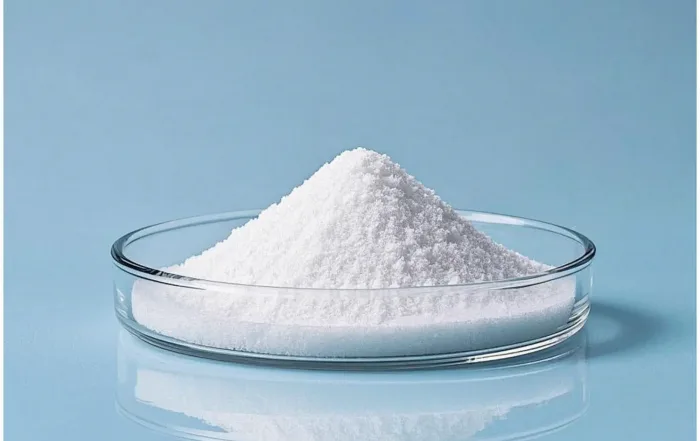
In the chemical industry, there exists a material that appears ordinary yet is truly indispensable. Because of its “finishing touch” role in countless reactions, it is often referred to as the “MSG of the chemical industry”—sodium hydrosulfide (NaHS).
As an important inorganic sulfur-containing compound, sodium hydrosulfide accounts for only a small proportion of overall chemical output. However, it plays an irreplaceable role in many critical process steps. Just as monosodium glutamate enhances flavor and balance in food, NaHS “enhances” chemical processes by improving reaction efficiency, increasing product purity, and optimizing production costs. In this sense, it brings out the “best flavor” of complex chemical systems.
1. Chemical Characteristics and Physical Properties of Sodium Hydrosulfide
Sodium hydrosulfide (NaHS) is a white crystalline powder with a molecular weight of 56.063 and the chemical formula NaHS. Its aqueous solution is strongly alkaline, and it is readily soluble in water and alcohol. When exposed to acids, it rapidly releases toxic hydrogen sulfide (H₂S) gas. NaHS is hygroscopic in air and decomposes upon heating, releasing H₂S. It has a melting point of approximately 350 °C, a density of 1.79 g/cm³, and a flash point of about 90 °C.
From a structural perspective, sodium hydrosulfide is the sodium salt of hydrogen sulfide (H₂S) and exhibits typical thiolate characteristics. The S–H bond within the molecule gives NaHS its distinctive reactivity. In chemical processes, NaHS functions as a strong reducing agent, sulfurizing agent, and basic catalyst, with its mechanisms mainly reflected in the following three aspects.
1.1 Reducing Action
Mechanism:
In aqueous solution, sodium hydrosulfide partially dissociates into Na⁺ and HS⁻ ions. The HS⁻ ion can further hydrolyze to generate H₂S, which acts as a strong reducing agent. It selectively reduces aromatic nitro groups (–NO₂) to amino groups (–NH₂), while exhibiting much weaker reducing ability toward aliphatic nitro compounds.
Representative reactions:
HS⁻ + H₂O ⇌ H₂S + OH⁻
H₂S + R–NO₂ → R–NH₂ + S + H₂O (simplified, incomplete equation)
1.2 Sulfurization Reactions
Mechanism:
Sodium hydrosulfide provides active sulfur species (S²⁻ or HS⁻), which act as nucleophiles in sulfurization reactions. These species form C–S and S–S bonds and serve as essential building blocks for sulfur-containing organic compounds.
Major reaction types:
Reactions with carbonyl compounds:
R–COCl + NaHS → R–COSH (thioacids)
Application: Synthesis of thioesters, thioamides, and other sulfur-containing compounds.
Reactions with aromatic intermediates:
NaHS can add to iminium salts (Vilsmeier intermediates), introducing thiocarbonyl groups and enabling the synthesis of sulfur-containing heterocycles.
1.3 Basic Catalysis
Mechanism:
Aqueous sodium hydrosulfide solutions are weakly alkaline (pH ≈ 9–10). This alkalinity originates from the hydrolysis of HS⁻ ions:
HS⁻ + H₂O ⇌ H₂S + OH⁻
Because the second dissociation constant of H₂S (Ka₂ ≈ 1.3 × 10⁻¹³) is much smaller than the ionic product of water (Kw = 1.0 × 10⁻¹⁴), the concentration of OH⁻ produced by hydrolysis exceeds that of H⁺, resulting in an overall weakly alkaline solution.
Catalytic applications:
In transesterification reactions, the basicity of NaHS promotes alcoholysis. For example, in reactions where nitro reduction and ester exchange occur simultaneously, NaHS can facilitate both processes in a single step.
A representative case is the reflux of 2-(2-nitrophenyl)imidazo[2,1-b]thiazole-6-carboxylic acid ethyl ester with NaHS in MeOH/H₂O. The HS⁻/OH⁻ system catalyzes ester exchange, directly converting the ethyl ester into the methyl ester in one step.

2. The “MSG Effect” of Sodium Hydrosulfide in Industrial Applications
2.1 Mining and Mineral Processing
- In mineral processing, sodium hydrosulfide serves as a flotation reagent for copper ores, exemplifying its “MSG effect”:
- Acts as a selective depressant, inhibiting the flotation of pyrite and other gangue minerals
- Enhances flotation efficiency of copper minerals
- Requires only small dosages (typically 0.1–0.5 kg per ton of ore) while delivering significant performance improvements
- In copper flotation, NaHS addition can increase copper recovery by 5–8% and reduce beneficiation costs by approximately 10%, clearly demonstrating its “small input, large effect” characteristics.
2.2 Leather and Tanning Industry
In leather processing, sodium hydrosulfide functions as a depilating agent and tanning auxiliary, playing a key “enhancing” role:
- Promotes hair removal by decomposing proteins in raw hides
- Works synergistically with tanning agents to improve softness and dye uptake
- Reduces processing time and energy consumption, increasing productivity
- Studies show that adding 0.5–1.0% NaHS can shorten depilation time by about 30% while minimizing damage to collagen fibers, significantly improving leather quality.
2.3 Dye Manufacturing and Organic Synthesis
In the dye industry, sodium hydrosulfide is a crucial intermediate for the synthesis of sulfur dyes. Its contributions include:
- Acting as an auxiliary to improve dye fixation and color fastness
- Providing sulfur atoms for the synthesis of organic intermediates such as thiophenols and thioaldehydes
- Serving as a reducing agent to convert oxidized dyes into soluble leuco forms during dyeing processes
2.4 Fertilizer and Environmental Industries
In fertilizer production, sodium hydrosulfide is used to remove elemental sulfur from activated carbon desulfurization agents. Its benefits include:
- Improving regeneration efficiency of desulfurization materials
- Extending service life
- Reducing overall desulfurization costs
- In wastewater treatment, NaHS acts as a precipitation agent for heavy metal removal:
- Forms insoluble sulfide precipitates with Cu²⁺, Pb²⁺, and other metal ions
- Achieves over 95% removal efficiency using only 1.2–1.5 times the theoretical dosage
- Reduces treatment costs by more than 30% compared with conventional precipitants

3. Safety and Environmental Considerations
As with culinary MSG, the effectiveness of sodium hydrosulfide depends on proper use. Misuse can “ruin the dish.” Due to its corrosivity and the release of highly toxic hydrogen sulfide gas upon contact with acids, strict safety protocols are essential.
3.1 Operational Safety
All operations must be conducted in a fume hood. Operators should wear respirators, corrosion-resistant gloves, and protective goggles.
3.2 Storage Requirements
Store in sealed containers, away from light, in cool and well-ventilated areas. Keep away from acids and oxidizing agents.
3.3 Emergency Response
In the event of a spill, evacuate personnel immediately and rinse the area thoroughly with large amounts of water to prevent H₂S accumulation.
3.4 Waste Treatment
Waste solutions must not be discharged directly. They should be oxidized to sulfate before disposal in accordance with environmental regulations.
Sodium hydrosulfide—the “MSG of the chemical industry”—embodies the principle of “small dosage, large impact.” Though it operates behind the scenes, it plays a decisive role in numerous industrial processes, making reactions more efficient, products higher in quality, and costs more controllable.
Just as MSG enhances the flavor of food, sodium hydrosulfide injects “reactivity” and precision into chemical processes, securing its position as an indispensable component of modern chemical industry.