The difference between nano-calcium carbonate and ordinary calcium carbonate (light or heavy) goes far beyond “smaller particle size”. From internal structure to external behaviour, and all the way to real-world performance, the two materials diverge in ways that are fundamentally qualitative.
Begin with particle size. Nano-calcium carbonate clusters between 1 and 100 nanometres—genuinely nanoscale—whereas light calcium carbonate typically ranges from 0.5 to 15 micrometres and heavy calcium carbonate from 5 to 45 micrometres. This orders-of-magnitude gap fixes the specific surface area: nano grades can reach tens or even hundreds of square metres per gram, ten to a hundred times that of conventional products. The resulting surface energy is correspondingly high, so the particles behave differently at interfaces and in chemical reactions.

Morphology tells the same story. Nano-calcium carbonate is grown under controlled conditions, giving regular crystals—cubes, spindles or short chains—that disperse easily and accept surface modifiers. Light calcium carbonate is also reasonably regular but larger and more prone to agglomeration. Heavy calcium carbonate is simply ground natural calcite; its particles are angular, rough and intrinsically incompatible with organic matrices.
Physicochemical properties follow naturally. Because a far larger share of their atoms reside at or near the surface, nano particles are markedly more reactive. They dissolve faster even in mildly acidic or neutral media and bond more strongly to polymers, hydration products and other phases, providing real reinforcement, toughening and densification. Ordinary calcium carbonate, by contrast, is basically an inert filler added to cut cost.
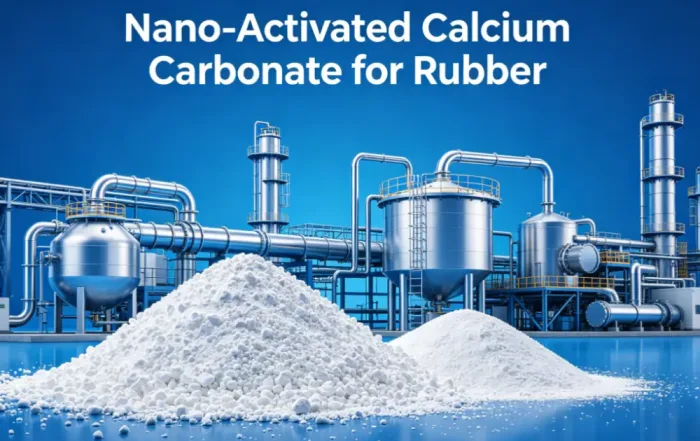
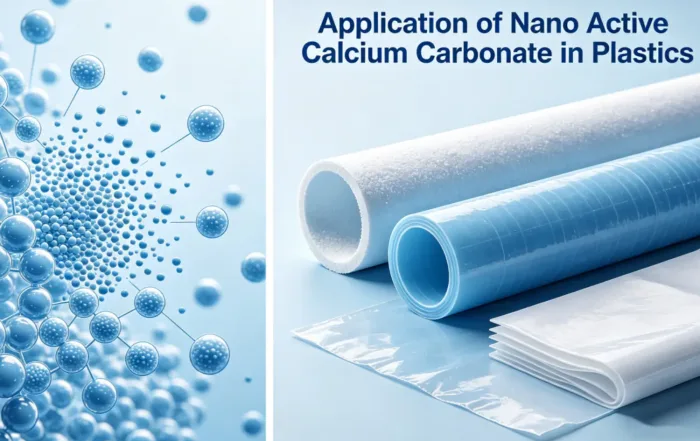
These contrasts are amplified in end-use. In rubber and plastics nano-calcium carbonate raises tensile strength, tear strength and abrasion resistance, while conventional grades merely add volume and can actually impair properties. In coatings the nano version tailors rheology and produces denser, more durable films; standard grades tend to settle and give uneven layers. In cementitious systems nano-calcium carbonate acts as nucleation sites that accelerate hydration, refine pore structure and boost early-age strength and long-term durability—effects that micrometre-sized particles cannot deliver.
The performance leap comes at a price. Making nano-calcium carbonate demands tight control of crystallisation, effective de-agglomeration and often surface coating, so it costs several times—and sometimes an order of magnitude—more than commodity grades. Heavy calcium carbonate is simply mined and ground, giving vast output at minimal cost; the light variety sits between the two and suits mid-range filling duties.
Taken together, nano-calcium carbonate is not a finer version of the same material but a functional species with high surface energy, high reactivity and strong interfacial coupling. It is reserved for demanding arenas—high-performance elastomers, engineering plastics, specialty paints, pharmaceutical carriers and high-strength cementitious composites—while ordinary calcium carbonate remains the workhorse for cost-driven, performance-tolerant applications. The relationship is one in which quantitative shrinkage in size triggers a qualitative jump in behaviour, not a simple matter of “coarse versus fine”.